


 Write a comment
Oswego is filled with many scenic views: Lake Ontario, the lighthouse, parks and of course, the sunset.
Oswego native Rocco Saya takes advantage of the beauty of his hometown by capturing breathtaking moments through photography. As the winner of iHeart Oswego’s previous Lighted Lighthouse Photo Contest, Saya expanded his photography skills to cinematography.
But he took that one step further.
Five months ago, Saya decided to use a drone to capture Oswego’s beauty. He assembled the drone in one day, and flew it the next.
“The very first time I took the drone to Fallbrook, I did a lot of practice,” he said. “When I did fly it the first time, I was very conservative. I went up a little bit in the air, then came back down. I took baby steps.”
Saya mastered how to fly the drone before beginning to film. He found there was a lot more to learn than it seems.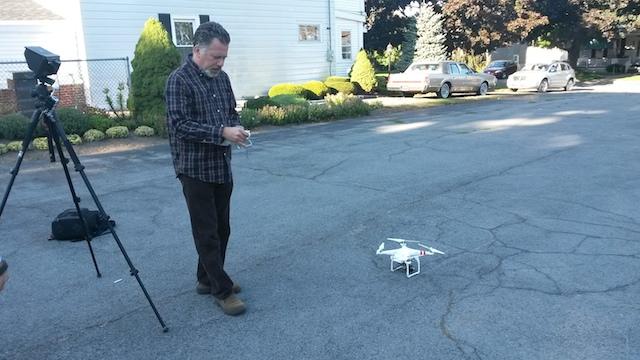
“A problem with flying drones is learning how to land correctly,” he said. “When you land, it’s pretty easy to tip the drone, and the propellers will hit the ground and break.
“It’s actually harder to break these than you might think, but of course they can always break if they hit a tree, which I’ve done before,” Saya said.
However, Saya learned that not all drones are destined to crash, as they do have the ability to be self-assisting.
“It’s capable of assisting me when I’m flying it,” he said. “They have flight-assistance software. You don’t have to be an experienced pilot to fly one of these.”
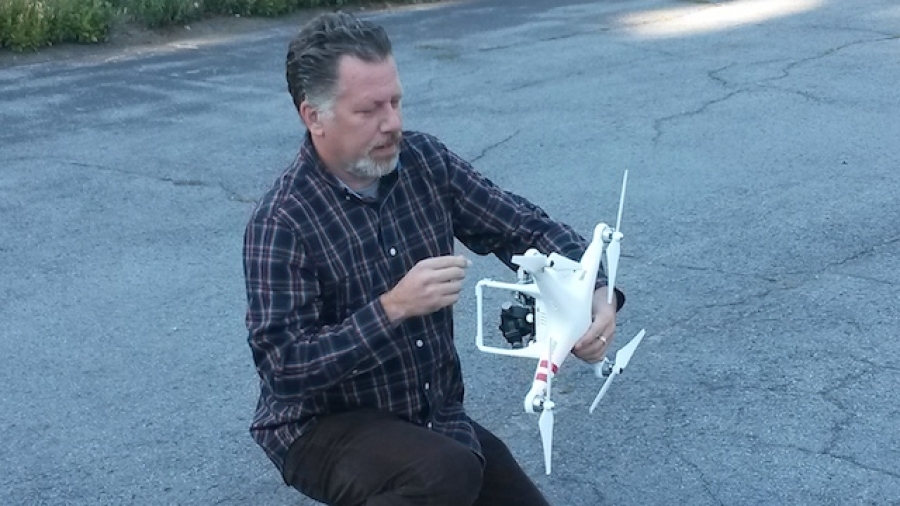
The drone comes equipped with a GPS, which collaborates with the drone’s software to monitor the drone’s moves through sensors. The drone even comes equipped with a compass.
“There’s a bunch of little parts in here that work together to essentially provide an amateur to be able to fly one of these,” Saya said.
The camera, a GoPro HERO3+ Black edition which is valued at around $450, is nested on a gimbal, which allows the camera to pivot, as well as pan up and down.
But Saya doesn’t just launch a drone in the air, film and then watch the footage at home.
“I need to know what I’m filming,” he said. “That’s where the transmitter comes into play. It will transmit the video that the camera is seeing in real time over 5.6 GHz frequency via air to the monitor. Once I fire this all up, I can then set the tripod down and see on the screen in real time what this is seeing.”
In the video below, Saya demonstrates this at the iHeart Corp. parking lot. He flies the drone in the air as iHeart Corp. founders Victoria Usherwood Gailinas and Phil Gailinas watched on.
“The best part of the demonstration was being able to see the city from the drone’s perspective through the live feed,” Usherwood said.
{youtube}HSAQq9P97AM|400|400|0{/youtube}
Once Saya mastered this technique, his goal of producing a short video of Oswego’s beauty was underway.
“Four months ago, I decided I wanted to do something positive,” he said. “I wanted to film sunsets, I wanted to film the shoreline on the lake, and I wanted to do that in a way that seems natural and show everyday life. Nothing is staged, nothing is set up, it’s just every day life in Oswego.”
Saya began filming well-known spots in Oswego such as the lighthouse, Breitbeck Park and Lake Ontario.
As a photographer, Saya knew it would take many tries to land the shot he wanted. He used his knowledge from photography and applied it to cinematography in hopes of producing breathtaking shots on film. He remembered the “Golden Rule” in photography, which applies to the landscape setting in the camera and applied it to film.
“It’s called the ‘Golden Hour,’” he said. “The ‘Golden Hour’ is shooting the scenery a half hour before sunset and a half hour after sunset. So you have only one hour to hit it. That’s when you have the best light.”
Saya spent about 200 hours completing the entire video, including editing and compiling scenes together to form a seamless video.
{vimeo}106260059|400|300|0{/vimeo}
The 4 minute and 37 second video took Saya four months to complete.
“I had to film some of those scenes many times,” Saya said. “Most of those shots were two to three takes before I was satisfied with a shot.”
Even though Saya shot each scene in the video at least three times over, there was one scene that stumped him the most: the shoreline scene.
“The longest scene to shoot was the shoreline under threat,” he said. “I can’t tell you how many times I was flying out there, trying to capture that beauty and failed. I can honestly say that it took me at least 15 to 20 takes to get a good shot.”
Through his quest to produce a high quality video of Oswego’s beauty, Saya’s drones suffered a few crashes along the way.
“I had a catastrophic crash trying to film with the [second] drone the first time,” he said.
Saya’s drone crashed, destroying the gimbal. The drone itself was damaged, but to Saya’s delight, it was still functional.
The second crash was crucial: the drone dropped into the waters of Lake Ontario and sank.
“I was very upset,” Saya said. “I thought, ‘Well, there goes $2,500 down the drain.’ So I swam out into the water and retrieved it. I called my wife and begged her to run to the store as quicky as possible and buy as much rice as she could to try and dry it out.”
Saya disassembled the drone and buried the pieces in a bag filled with 100 pounds of rice. He left the pieces in the rice for 48 hours.
“Everything survived,” Saya said. He was even astonished himself that the drone survived the wet downfall.
“The only thing that seemed to have a lasting damage is one battery, which doesn’t charge to 100 percent, but i’ll take it,” he said.
The drone has about $600 worth of batteries.
After that incident, Saya successfully completed “Fly Away Home.”
“It’s something I’m sharing with the community, I’m giving back to my fellow community members,” Saya said. “My Halloween displays, my Christmas displays, that’s all something I like to share with people.”
Saya’s decorating skills are well known throughout his neighborhood, as friends and neighbors look forward to his holiday decorating. This year, however, Saya said that due to his lavish, yet intriguing drones, he is limited as to what he is able to purchase for decorations.
“I’m not allowed to buy certain things for Halloween,” Saya jokingly said.
Saya hopes his work will continue to brighten up anyone who sees it.
