





 Write a comment

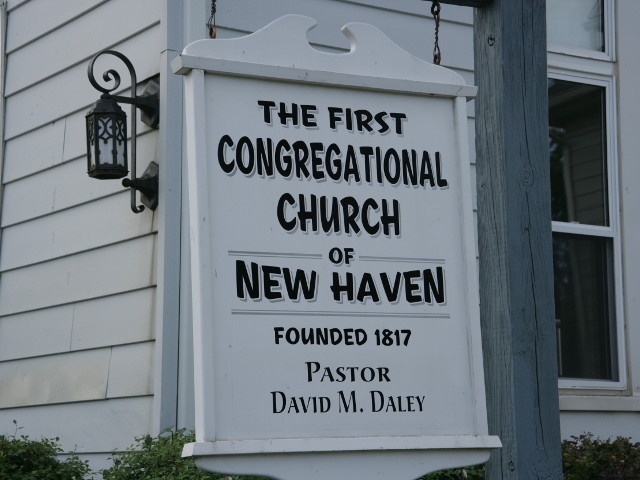
The First Congregational Church of New Haven, New York, is moving into it's another century this year, after celebrating the 200th anniversary of it's founding last year.
The church is said to be the oldest continuously existing congregation in Oswego County (founded 1817) and has the oldest church building still in use (built in 1827).
These two factors make the church and it's records particularly important for scholars of eclesiastical history simply because of the fact that since the building still exists so do the church's records. These documents are original sources which are unavailable anywhere else and have been used by historians to extend the range of the so called Burned Over District into Oswego County. Heretofore this district was thought to be in force in primarily in western New York.
In the early nineteenth century, Upstate New York’s “Burned-Over District,” was an area characterised by many Christian revivals and religious innovations that continue to have impact today. The would include the Morman church, The Spiritualist Movement,The Shakers, and experiments like the Oneida commune. Conversions to new religions and theologies were abrupt and emotional.
Many secular reforms also blossomed as well. In the 1830s the area was at the heart of the abolishionist movement. And in 1848 in nearby Seneca Falls, a handful of women held the first Women's rights convention begining the Sufferagette movement which would eventually free women from the many restrictions which bound their lives and give them the right to vote.. It was the women, too, who were involved in the temperance movement dedicated to the restriction of alcoholic beverages which would lead to Prohibition in the 1920s.
The First Congregational Church of New Haven was in the forefront of many of these movements. Just this past summer the Church dedicated a Pomeroy State Historic Site Marker commemorating an abolitionist meeting held at the Church in 1833. And in all probability the church providied shelter for runaway slaves traveling on the underground railroad system. In addition several pastors were were known to be leaders in the temperance movement
As for women's rights the Church started ahead of the curve compared to the rest of the country by granting full membership and voting rights to women. This was true from the very first meeting where a majority of the founding members were female.
By the end of the nineteenth century the Women's Fellowship group of the church had assumed control over the church's new social hall, kitchen and sunday school complex located to the east of the original building A structure that was built with funds provided by a donation made on behalf of Mrs. C. Sidney Shepard, a wealthy member of the church.
To this day the women of the First Congregational Church of New Haven continue to make a difference in their church and their community. A good example this would be the members of the Mullen family with the mother, Rose, and her daughters Kristina and Emily.
Rose Mullen is the chairperson of the church fundraising comittee, the head of the board of deacons, ands well as pursuing a career as a fulltime childcare provider.
Daughter Emily Mullen is Sunday school superintendant at the age 21 along with membership in the church Board of Deacons. She also is active in the local comunity, sponsoring youth holiday parties throughout the year, organizing school supples give aways, and Fall and Spring craftshow fundraisers for the church. She does all this while working as a nursing Assitant in charge of a floor at The Seneca Hill Heath Care Facility.
Daughter Kristina Mullen, is a Sunday School teacher and a Jr. Deacon and is the leading light in the school supply giveaway that the church holds every year. She also helps her mother and sister out with many of the things they do for the church and community. She is also a senior at Mexico High School.
These fine, useful, women represent just few of the good people who are members of the vibrant community that is The First Congregational Church of New Haven. A congregation that throughout the last two centuries has contiued and will continue to serve God, as well as the local community.
