


 Write a comment
Although Oswego native, Robert Schladebeck no longer lives in the Port City, his love of Oswego remains. So does his love of lighthouses, in particularly the Oswego West Pierhead Lighthouse.
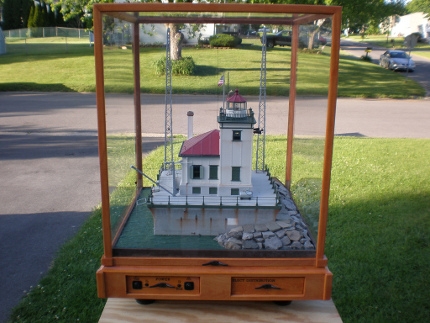
Schladebeck has spent the last five years devoted to replicating a 1:48 (one real measured inch equals 48 scale inches) scale model of Oswego's iconic lighthouse and it is now on display for the summer at the I Heart Oswego office at 7 W. Bridge St.
"When it was brought to my attention that a fellow member of the OHS class of '78 had created a replica of the Oswego lighthouse, we felt an obligation to share it with the entire Oswego community," said I Heart Oswego founder, Victoria Usherwood Gailinas. "It is on display in our front window and we invite the entire community to drop by at some point over the summer to see all of its amazing detail."
Schladebeck, who is currently living in Clay, joined the U.S. Air Force right out of high school, retiring in 2000 with an associates degree in avionics. Over the years, he was stationed Oklahoma City, Iceland, Anchorage, Alaska, and two consecutive tours in Texas.
"I took up scratch building not long after I moved to Clay," he said. "The first (model) I made was a 1:24 scale of the Apollo 11 lunar module. I couldn't find one, so I built one."
But, Schladebeck said, it has always been lighthouses that he has really admired.
"I love lighthouses; I always have. I should have been a sailor," he said with a laugh.
At first, Schladebeck said he was simply going to draw the lighthouse, but since he had made the lunar module, he decided to try and build a model of the lighthouse as well. He said it was not long before he became a little overwhelmed by the details of the project.
"Needless to say, my painfully obvious orientation to detail added many months to the project," he admitted.
Using old Coast Guard aerial photos, Schladebeck said he based his model after what the lighthouse may have looked like in the late 1950s.
"It was hard to tell the from the photos, so I accessed what the colors probably were at that time," he said. "To me, the towers were distinctive and that was what made the lighthouse special. In our day, they were painted red and white, but prior to that I figured they were red or gray, so I guessed gray. I haven't found anyone who could actually give me that information."
He said he once had someone argue with him that there were never towers on the lighthouse.
"She was floored when she was shown photos of the towers," Schladebeck said.
He said the first version of the lighthouse caisson started out as a combination foam and foam board, to which he had intended to add layers of concrete patch to give the appearance of concrete.
This approach quickly revealed its faults, Schladebeck said.
"Making the caisson base out of wood was the best choice," he said, adding that it did, however, require extensive experimentation before he found a way to nicely simulate concrete.
"Plus extra work to Dremel out the various notches for ladders, doors, windows and hatches," he pointed out.
Schladebeck said his first real "break" for the project was when he found a textured paint he could modify nicely to look like concrete.
In June 2009, he kayaked to the real lighthouse scouting for details and pictures.
"It was the first time for me near the real thing," he said.
The second turning point of the entire project for Schladebeck was in September of the same year when he walked the breakwater to the lighthouse, taking more than 100 pictures of the deck and building details.
The result is a scale model with working lights, breakwater and so much detail his work was was awarded "Judge's Best of Show" and "Best Diorama" at the International Plastic Modeler's Society's (IPMS) yearly SYRCON model contest in October of 2012. It was also displayed at the Great New York State Train Fair at the fairgrounds held in November.
"I think it is great and I was so honored by Victoria and Phil (Gailinas) wanting it on display in their downtown office," Schladebeck said. "I really wanted to share it with the public, but it needed to be somewhere secure and safe where there is little chance of it to get damaged. Before that it has just been sitting in my family room. I hope a lot people get the chance to see it."
Robert Schladebeck currently resides in Clay with his wife, Linda. They have two grown children, Amber and Michael.
Scroll down to view a gallery of photos depicting the progression of the lighthouse as built and described by Schladebeck.
