


 Write a comment
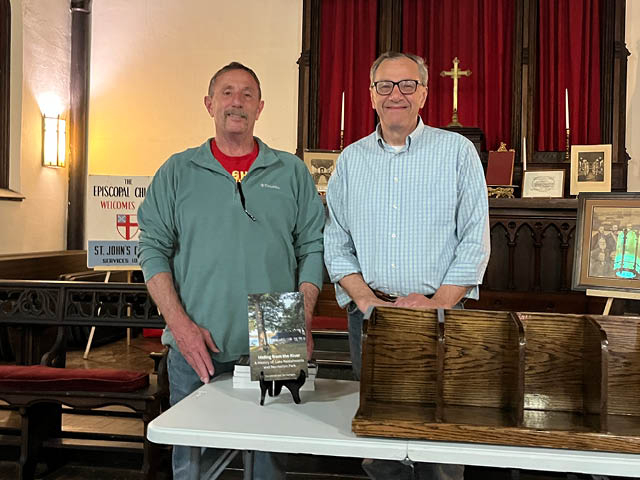
Tuesday night, the Schroeppel Historical Society opened their 2025 season with a presentation from Jim Farfaglia and Tim Carroll.
The presentation, A History of Lake Neatahwanta and Recreation Park, started with the personal memories of the two presenters, who both grew up in Fulton in the 60s and 70s. The duo are out promoting their new book, Hiding from the River: A History of Lake Neatahwanta and Recreation Park.
This incredibly informative history delved deep into the area’s geological and social past, beginning with the formation of Lake Neatahwanta by the same glacier that also formed a number of other local bodies of water, including Peter Scott Swamp and Oneida Lake. The lake was originally part of a much larger body of water known as Lake Iroquois, which eventually became Lake Ontario.
The two presenters then discussed the history of human settlement of the region, starting with a Paleolithic civilization approximately 12,000 years ago. The Haudenoshonee who eventually built permanent settlements in southern Onondaga County relied on the Oswego River, Lake Neatahwanta, and other bodies of water in Oswego County for yearly fishing expeditions.
When Europeans arrived in Oswego County, Carroll noted some of the many different names that were given to the lake prior to the recognition and re-adoption of the name given to it by the Haudenoshonee. The most notable of these were Fish Lake, popular in the early 1800s, and then Granby Lake.
European settlers later developed the east side of Fulton with factories, leaving the west side as an agricultural center. This paved the way for the creation of the Oswego County Agricultural Society in 1840, which began holding an agricultural county fair that same year in various locations across the county. By 1855, the fair was moved permanently to the shores of Lake Neatahwanta. Because New York State did not yet host a state fair, the county fair in Fulton was a huge regional draw, bringing in tens of thousands of people for horse racing, acrobatics, and much more across the decades.
However, by the 1920s, Fulton was much more of a factory town than an agricultural center, and so the county fair moved to Sandy Creek. After this move, American Woolen Mills General Manager John Stevenson purchased the lakeshore property from the Oswego County Agricultural Society, building out an enormous auditorium and a dance pavilion for holding a wide range of community events. He also had a carousel custom-made for the event center—one this writer’s very own grandfather fondly spoke of riding as a boy.
All of the activities held here were free to the community courtesy of the woolen mill. Its opening day in 1922 was attended by an enormous crowd of 20,000 people.
The sheer amount of community-building that has happened on the lake shores over the years is astounding. Even today, 2.5 miles of contiguous lake shore is zoned for public access, an incredibly rare gift that offers the community a great place to birdwatch, hike trails, and come together with beautiful views.
What’s in a Name?
A common misconception among Fultonians today is the translation of the lake’s name: most people learned that Neatahwanta means “Little Lake by the Big Lake.” In their research, Carroll and Farfaglia uncovered the truth through Onondaga Nation resident Albert Cusick, who became the Chief of the Six Nations of the Haudenoshonee Confederation. Cusick told local clergyman and archaeologist William Beauchamp that the name means “Lake Hiding from the River”—an apt descriptor for a lake so easy to miss while navigating the Oswego River.
Despite the hyper-eutrophication issues that led to the closure of the lake to swimming in the late 1980s, there is hope for the water itself to be enjoyed again. Dredging and other reclamation efforts have begun showing results, with nutrient load dropping over the last several years. While it’s uncertain when the water will be safe for swimming, boating, and other recreational uses again, it is certain that we are moving in the right direction.
With Carroll going into the scientific details and Farfaglia fleshing out historical and cultural elements, the pair offered an in-depth look into Lake Neatahwanta’s past—and a vision for its future. “This isn’t just the story of a lake—it’s the story of a town,” Farfaglia said. “We are hoping to inspire the next generation to see what the lake has to offer.”
The pair’s book is available for purchase on Amazon as well as locally.
If you would like to support the Schroeppel Historical Society, please stop by the Schroeppel Historical Society for their annual plant sale on May 26 during the Phoenix Memorial Day Parade. The society is currently looking for members of the public interested in becoming members; dues help preserve their historical collection and maintain the building.
Their next event will be held on Tuesday, June 17th at 7pm; just in time for the Erie Canal’s 200th anniversary, they will be hosting Derek Pratt for a talk entitled, “Erie Canal: Open for Business.”
