


 Write a comment
My first job ever was as a paperboy for the Pall-Times, with a route that had 142 customers, one of the largest routes in the city.
I first learned the route by tagging along with Harry Lennon, paperboy extraordinaire, and when he retired to play HS football, I took over at the age of 12, and had the route for the next four years, until my junior year in HS. The route ran along Seneca Street, starting at Eighth Street, all the way to Fifth Avenue near the college, and everything north of Cayuga and Bridge Streets. I would ride my bike in the good weather to the West Second Street pressroom of the Pall Times, where the smell of fresh ink permeated the air, and you lined up for your stack of papers every day at around 3:30 pm. I would then proceed to the corner of West Fifth and Seneca Streets, and sit on the stone wall folding papers, meaning making them throwable, and stuffing them into my double sided delivery bag on the back of my red 26 inch Raleigh bike, replete with back fender platform, so I could ride along and toss them on people’s porches as I rode. In the bad weather months, I would have the bag over my shoulder and it was a heavy load. Even now, I get crinks in my neck and shoulders, which I attribute to those paperboy days. If you were lucky, you could make $15-17 a week as a paperboy. The papers cost seven cents back then, so the typical collection per customer was $.42 per week, for six days of delivery. The papers cost us five cents, so you could make two cents per paper. Then there was always the New Year’s calendar, when you would get special tips from everyone, and that usually amounted to about a dollar per customer. $142 was a lot of money back in 1959. So I did very well as a paperboy.
I did try to organize a paperboys union, however, and that effort failed. My dad, at the time, was the head of the International Typographical Union at the Pall Times. He was a linotype operator, and was the union spokesperson during their collective bargaining, so I tried to emulate my dad’s organizational skills on behalf of the paperboys, shortly after which I was told my route was being cut in half, since it was too big for one paperboy. I always blamed Pall Times publisher Clark Morrison for that move, but it forced my retirement, and allowed me to concentrate instead on my avocation as a disc jockey.
I actually sent in an application to be a contestant on “What’s My Line?”, a popular TV panel show in which famous panelists would try to guess the identities of other famous guests, and what their line of work was. I applied, thinking that I might be uniquely qualified as I was probably the only teenage disc-jockey who also maintained a daily paper route. I got a thank you but no thank you response, so maybe I wasn't that unique after all.
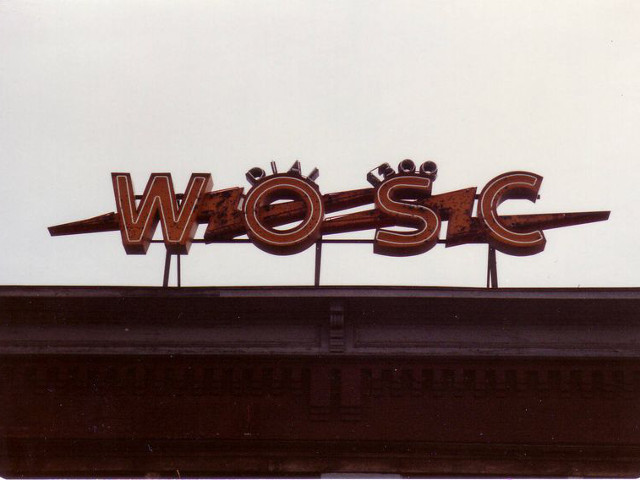 I started my disc jockey career at the age of fourteen, as a freshman in high school, when I approached the manager of WOSC radio with an idea for a Saturday morning radio program featuring “rock and roll” and dedications and requests. I practiced every day by reading the newspaper into my Webcor reel to reel tape recorder, and tried to emulate the way Walter Cronkite talked, with “general American speech”, devoid of any colloquialisms.
When you are from central New York, you speak with a flat “A”. People from Syracuse and Oswego tend to break small words into two syllables, like hat, cat, rat...becoming hay-ut , cay-ut, and ray-ut. I tied consciously to rid myself of any colloquialism in my tone and inflection, and believe that I have actually succeeded over the years, as people cannot tell by the way I speak from whence I hail.
Fred Maxon, who was the Assistant Station Manager at WOSC, agreed to meet with me, and he kind of laughed me off at first, but told me that if I could come back with five solid sponsors, he would consider putting me on the air. Within a week, I was back with six sponsors, of $5 each, and Fred said, "Ok, you’re on!" I started in the front studio with the window facing out on Bridge St., and John Stone, the radio station’s engineer, running the controls. Eventually, I graduated to running the board, controls and turntables all by myself, replete with headphones, and “The Live 25” was born. We featured the top 25 songs of the week, and I mimeographed the list and it was put in the window of Fred’s HiFi record shop each week. Back in those days, you could go and try out 45 rpm records in a record booth, and Fred’s Hi-Fi was the place to do it. We promoted the show as “The Live 25 in Hi Fi Jive”! and it became a pretty popular program on 1300 am radio every Saturday morning from 10-12 am.
In later years, once I got my drivers license, I would work weekends at the radio station’s principal studio on the shores of Lake Neahtawanta in the Town of Granby, near Fulton. Part of my heart, and certainly part of my roots will always be in Fulton. More on that later, but for now, as a 16 year old Disc Jockey at WOSC radio, I have many fond memories of my broadcasting days there on Lakeshore Rd. ( It wasn't called Lakeshore Road back then). It was actually called N*****rville road, and when the station applied for re-licensure in 1964 after the Civil Rights Act had passed, the FCC denied the license renewal unless the name of the road was changed. The Town of Granby was petitioned, and they refused to change the name of the road. It ran along an old muck farm near Lake Neahtawantah. So, Station Manager Jack Burgess re-submitted by naming the driveway of the station “Radio Road”, and it was finally approved. The Town did later change the name to Lakeshore Road, but to this day, the station is listed as being licensed with the FCC on ” Radio Road”, Fulton, N.Y.
I moved on from ”The Live 25 in Hi-Fi Jive", broadcast from WOSC’s downtown Oswego studios at the end of the Bridge St. bridge to being a regular weekend broadcast DJ.. I hosted the “Wonderful Weekend” program, and the “Jack Sullivan Show” on Saturdays and Sundays, while in high school and later in college. My then girlfriend and later wife Charlotte McQueen recorded the jingle for the show…”Wonderful wee-eek-end”. In college, I switched stations to WSGO in Oswego, “Your hometown station” , whose studios were in the back end of the American Legion building on West Bridge Street, after being briefly located in the Hotel Pontiac. I have lots of stories to tell about those old disc jockey days, and several of them are contained in the upcoming Memoirs of a Small Town Mayor book. The book is on target for publication by late summer or early fall of this year. So as they say, be sure to stay tuned!
