


 Write a comment
A New Year and a new column, and so it goes. This new column, "Memoirs of a Small Town Mayor", will be an opportunity for me to share excerpts from my upcoming autobiography, "What Color Is Your Table?", along with musings and anecdotes from times current and past. I will endeavor to tell stories, past and present, and give my perspective on happenings and events. This column will appear twice monthly on iHeartOswego.com.
This first column deals with how I came up with the title for my upcoming autobiography.
When your life and general health and well being becomes dependent upon the approval and approbation of thousands of strangers, you have to begin to wonder. How did this come to be? What path did I choose to go down that has resulted in such a dependency on positive poll numbers? How do I, or did I, get off that well worn and sometimes triumphantly trodden track?
Well, I am not sure I can, or did. There is a tinge of political in every interaction I have with other human beings. In short, I've never stopped running for mayor, seeking approval, and trying to find whatever link I might have to connect me with the person of the moment with whom I am conversing.
For me, I trace those roots back to Kindergarten. It was Sister Stanislaus's Kindergarten class at St. Mary's school in Oswego, New York, where I first began to develop and refine my political skills, such as they are. We called her Sister Santa Claus. She was a tall, pretty, and pleasant nun who was a member of the order of the Sisters of St. Joseph of Carondelet. Her motherhouse was in Latham New York, and her heart was in her Kindergarten classroom on the first floor, just to the right of the front entrance, with a "cloak room" separating the first and second grade classrooms. There was an upright piano in the classroom, which Sister Santa Claus delightfully played to entertain and motivate us. The tables we sat at were brightly colored, and had a sort of social pecking order, with the red table being the " first class" seats, and the Orange table for the other side of the track types.
Proudly, I would often occupy the first seat at the red table, across from the queen of our Kindergarten class, Kathy Quigley, the undisputed bright and beauteous "first in our class" . Her father was a Doctor and they lived in a very big house, and she had the biggest and best birthday parties I ever attended, throughout my grammar school years.
How I came to claim the premier seat at the red table, I am not entirely sure. I often would jockey for that position with Joey Jadus and Gary Dehm, beknighted princes of the K class themselves, I was a year younger, having been allowed entrance to school after a personal dispensation from pastor Rt. Rev. Monsignor Edward G. Quaid, who, after interviewing me, decided I could pass muster for entrance with kids a year older than me. I was four years old in September of 1951, and did not turn 5 until February 27th of my first year in school. Ironically, Kathy Quigley turned five on February 22nd, so we were Pisces soul mates.
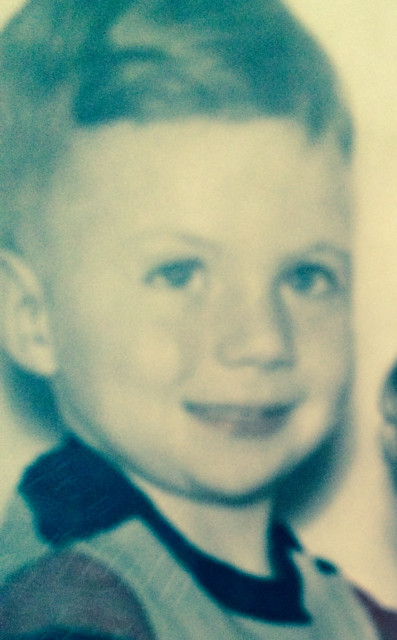 Why was it so important to be at the first seat at the red table? I guess we learn social competitiveness at an early age. I hesitate to think about the self limiting prospects of those who wound up repeatedly sitting at the Orange table. We were , for the most part all kindred spirits with orange table qualifications, but some of us strove to be seated at the red table, while to others, it mattered not.well, to me, for some reason it mattered. We red table kids did exhibit the occasional boogery nose, and we're not always decked out in Easter finery. Nevertheless, the emphasis on social ordering, as I remember it, is certainly worth examining . I am told that in the public schools of the day, students were assigned seats based on alphabetical order. I think that did happen as I moved into the upper grades, but in Kindergarten, we thought that public school kids were other side of the track people too. Call it Catholic snobbery, or pre-Vatican II Roman Catholic culture, but that is what I remember of it, be it right or wrong. It was certainly formational for all of us. Maybe it is true as the author Robert Fulghum says, "All we needed to know we learned in Kindergarten".
If memory serves, the pecking order was red table, blue table, green table, yellow , and then orange, with 6 kids at each table. Somehow we kind of naturally found the right table to sit at and allowed a natural progression of the pecking order to be established.
I do remember one time when I peed my pants, had to go stand behind the piano for a time, and then was directed by Sister Santa Claus to sit at the Orange table. I was so devastated by that defrocking that I never peed my pants again. It's 63 years later, and I still haven't peed my pants again. Thank you , I think, Sister Stanislaus, for that object lesson in life . Pants pee-ers are relegated to the Orange tables of life. So pee not in your pants, lest ye slip into the dregs of society. It's Dry pants people who rule the world. (insert Kindergardten pic)
