














 Write a comment


A Fresh Start? The Realities of a New Year
Before we dive into the latest political firestorm, let me just say—I genuinely hope you had a chance to catch your breath over the holidays. Whether you spent it surrounded by family, squeezing in a little travel, or just enjoying some much-needed quiet, here’s hoping the new year brought you a bit of joy (and maybe a few leftover cookies).
It’s funny how, every January, we all talk about fresh starts and resolutions—getting back to routines, tackling new goals, maybe even finally sorting out that closet we ignored all last year. But while we’re all trying to hit reset in our own lives, the world outside seems determined to keep things as unpredictable as ever. And nowhere is that more obvious than in the ongoing saga at the border, where ICE, Border Patrol, and the government shutdown are already making headlines.
So, as we settle into 2026—coffee in hand, to-do list half-written—let’s talk about how we got here, and why this year’s immigration debate feels like déjà vu all over again.
America's Immigration Plot Twist: From "Whites Only" to "It's Complicated"
Let’s be real—U.S. immigration policy has always been a wild ride, but one constant is that it’s never just about one group. From the jump, the rules were written to decide who belonged and who didn’t, shaping the fate of Native Americans, Black Americans, Asians, Latinos, and basically anyone who wasn’t the “right” kind of newcomer. Every era, a new set of folks got the short end of the stick—sometimes by law, sometimes by loophole, but always with real lives on the line. If you ever wondered why so many people feel left out of the American story, just look at the immigration playbook: it’s a rotating cast of exclusions, exceptions, and “maybe next time” promises.
To understand how we got here, check out the timeline below. Seven distinct eras shaped America's approach to immigration—each one a reaction to whatever crisis, economic shift, or political panic was happening at the time. From explicit racial exclusion to bureaucratic quotas to post-9/11 security theater, you'll see the pattern: the methods change, but the gatekeeping never stops. It's a visual reminder that immigration policy isn't just abstract politics—it's the story of who America decided to let in and who it left out.
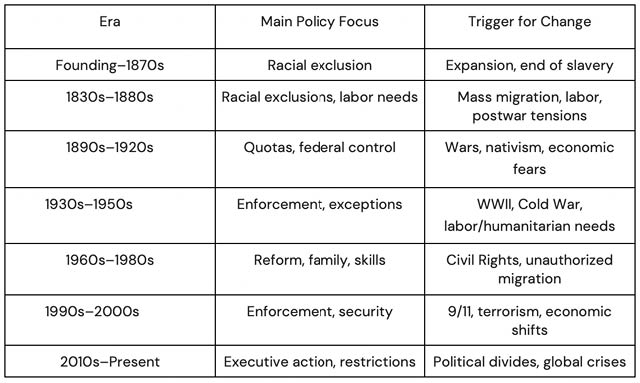
The early chapters? Yikes. The 1790 Nationality Act literally said citizenship was for "free white persons" only—and yes, they were that blunt about it. Fast forward through westward expansion, slavery's end, and suddenly America realized it had a tiny problem: turns out you can't build a country on racial exclusion forever (plot twist: you actually can't). But instead of learning that lesson, we just got more creative. Enter the Chinese Exclusion Act of 1882, the first time Congress said "this specific group? Nope." It was like the training wheels for systemic discrimination—explicit, unapologetic, and absolutely wild by today's standards.
By the 1920s, things got bureaucratic. The Johnson-Reed Act slapped down national origin quotas, and suddenly immigration had spreadsheets. The government basically said, "We're going to scientifically prove some countries are better than others," which, spoiler alert, was pseudoscience dressed up in policy. Then came the curveballs: WWII and the Cold War forced America to make exceptions (Japanese internment was happening while we were recruiting immigrant labor). The 1965 Hart-Celler Act finally ditched the racial quotas, but by the 1990s, post-9/11 paranoia swapped racial exclusion for security theater. Travel bans, employer sanctions, enforcement expansion—we just rebranded the gatekeeping. Today? We're stuck in a loop of executive orders, DACA limbo, and partisan gridlock, where immigration policy gets rewritten every four years depending on who's in charge. Same chaos, new decade.
The Pendulum Swings
A Tour Through Recent History | How Each Administration Changed the Game
Let’s fast-forward to the 21st century, where immigration policy basically turned into a high-stakes game of musical chairs—except the music is always on edge and nobody actually gets a seat. Bush kicked things off with a “security first, reform never” vibe, pumping up border funding and talking big about fixing the system, but real reform? Not so much. Then came Obama, who tried to walk the tightrope between enforcement and compassion. We got DACA, sure—but also a record number of deportations. Turns out, “hope and change” sometimes meant “change… but also a lot of paperwork and mixed signals.”
Then the dial got cranked up to eleven. Trump’s first term brought “zero tolerance,” travel bans, family separations, and a wall (some of it physical, most of it political). Cue the chaos. Biden entered with big humanitarian promises—think DACA protections, more refugee admissions, a softer tone—but reality hit fast: border surges, political gridlock, and a return to tough enforcement when things got messy. And now, in Trump’s second act, it’s mass deportation mode: expanded travel bans, detention centers at capacity, and the most restrictive policies yet. If you feel like the rules change every election cycle, you’re not wrong—immigration policy in America is basically a never-ending reboot, and the drama just keeps coming.
Now, let’s break it down administration by administration—because if you’ve ever felt whiplash trying to keep up with who’s allowed in and who’s being shown the door, you’re not alone. Each president in the last two decades has brought their own brand of border drama, executive orders, and headline-grabbing policies. From Bush’s post-9/11 security surge to Obama’s balancing act, Trump’s “zero tolerance” theatrics, Biden’s humanitarian reset (with air quotes), and the current mass deportation blitz, it’s a wild policy ride. So, buckle up as we take a closer look at how each White House put its stamp—and sometimes its foot—on America’s immigration story.
Two Decades of Immigration Policy: What Actually Happened
"Comprehensive Reform" Was Just a Slogan
Bush (2001–2009):
Let's start with the post-9/11 era, where Bush walked in with big talk about "comprehensive reform" and walked out having done... basically nothing comprehensive. Sure, he pumped border security funding up by 159%—that's not nothing—but his grand vision of a temporary worker program and legalization pathway? Dead on arrival. Congress wasn't interested, and neither was the political will. So what did we get instead? Enhanced screening, more enforcement, and a whole lot of promises that never materialized. The real legacy? Bush set the template for every president after him: talk big about reform, deliver only enforcement. It's the immigration policy equivalent of saying you're going to the gym and just buying the membership.
The "Deporter-in-Chief" Paradox
Obama (2009–2017):
Here's where it gets messy. Obama came in with humanitarian vibes and left with a record—and not the kind he’d intended. He deported nearly 2.7 million people, more than any president before him, earning the nickname "Deporter-in-Chief" from immigrant advocates. But wait, there's more: he also created DACA, protecting roughly 700,000 undocumented youth and giving them work authorization. So which Obama are we talking about? Both. He tried to thread an impossible needle—being tough on enforcement while protecting vulnerable populations—and ended up satisfying nobody. DAPA (his attempt to expand protections to undocumented parents) got blocked by courts. Comprehensive reform? Failed in Congress. The takeaway: Obama proved that you can be progressive on paper and brutal in practice. Executive action on immigration became his workaround when Congress wouldn't cooperate, setting a dangerous precedent that the next guy would absolutely exploit.
"Zero Tolerance" Wasn't a Policy, It Was a Cruelty Campaign
Trump Term 1 (2017–2021):
Then came Trump, who didn't bother with the pretense. Zero tolerance meant exactly that—no nuance, no exceptions, just maximum enforcement. He issued 472 administrative changes on immigration (more than any other president), implemented a travel ban on predominantly Muslim countries (eventually expanded to 19 countries and upheld by the Supreme Court), and started building a wall. But the real horror show? Family separation. Children ripped from parents at the border, traumatized, lost in the system—all in the name of deterrence. It didn't deter anyone; it just broke families. Meanwhile, refugee admissions plummeted from 110,000 to 18,000. DACA survived only because courts blocked his attempts to kill it. The "Remain in Mexico" policy forced asylum seekers to wait in dangerous conditions. And the Public Charge Rule? That basically said: if you're poor, we don't want you. Trump didn't just enforce immigration law; he weaponized it. The outcome: the lowest refugee admissions in decades, the highest number of executive actions on immigration, and a border wall that cost billions and didn't solve anything.
Good Intentions, Terrible Timing, Worse Optics
Biden (2021–2025):
Biden walked in promising to reverse Trump's cruelty. He ended the national emergency, increased refugee admissions to 125,000 (the highest in decades), expanded DACA, and tried to push comprehensive reform. Sounds great, right? Except reality had other plans. Border crossings surged—not because of Biden's policies, but because conditions in Central America were dire and word got out that maybe, just maybe, there was a path forward. By 2024, Biden panicked. He issued a proclamation to shut down the border if crossings exceeded 2,500 per day, restricted asylum access, and basically adopted Trump-lite policies. So what did he accomplish? A mixed legacy that nobody's happy with. Immigrants felt betrayed by the enforcement pivot. Republicans said he was too soft. And comprehensive reform? Dead on arrival in Congress. Biden proved that even good intentions can't survive political pressure and border chaos.
This Is What "Maximum Enforcement" Actually Looks Like
Trump Term 2 (2025–Present):
And now we're here. Trump's second term isn't just stricter than his first—it's operating in a completely different universe. We're talking mass deportation: roughly 605,000 people deported in the first year alone. Travel bans expanded to 19 countries, including the Palestinian Authority. A $170 billion enforcement bill (OBBBA) passed to fund detention and deportations. ICE is raiding workplaces, targeting mixed-status families, and detention centers are at capacity. Due process? Eliminated. Asylum? Effectively closed. Refugee admissions? Halted. The language itself has shifted—immigration is now framed as an "invasion," militarizing what used to be a policy debate. This isn't comprehensive immigration reform; it's comprehensive immigration elimination. The numbers are staggering: the highest deportation numbers in U.S. history, the most expansive travel bans ever, and a detention system bursting at the seams. If you thought Trump's first term was harsh, this is what happens when there's no institutional resistance and no court willing to stop it. This is the endgame of 20 years of political gridlock, failed reform, and escalating enforcement rhetoric.
The Pattern Nobody Wants to Admit
20 years of failed reform leading to escalating cruelty
Here's the thing: for 20 years, every administration—left, right, center—has failed at comprehensive reform. So instead, they've all doubled down on enforcement. Bush tried and failed. Obama gave up and deported millions. Trump weaponized it. Biden tried to reverse it and then gave up. And Trump 2.0 is just running with it full-speed. The result? A system that's broken, inhumane, and getting worse every cycle. Immigration reform isn't coming. What's coming is more walls, more detention, more deportations, and more families torn apart. Because apparently, that's easier than actually fixing the system.
The Shutdown Effect
Why Immigration Is the Ultimate Political Stalemate:
Here's the thing: immigration isn't just a policy debate anymore—it's literally shutting down the government. In October 2025, the U.S. government went dark for 42 days because Congress couldn't agree on immigration enforcement funding and healthcare. The central issue? Trump's immigration policies. Then, just a few months later in January 2026, another shutdown hit—this time triggered by a CBP incident where Border Patrol agents killed a VA nurse named Alex Pretti on January 24th. Senate Democrats withdrew support for the DHS funding bill, the whole deal collapsed, and Congress couldn't pass a budget. All because immigration enforcement became so politically toxic that lawmakers literally couldn't agree on how to fund it. This isn't about solving the border crisis—it's about two sides using it as a weapon.
The Real Numbers That Show Why This Is Broken
Let's talk about what's actually happening on the ground. In 2025, Trump's mass deportation campaign deported approximately 605,000 people—the highest number in U.S. history. That's not a policy success story; that's a system operating at maximum capacity, tearing apart families, and creating humanitarian crises. Meanwhile, the 2026 shutdown was triggered by a single incident—a CBP killing—that exposed just how volatile and militarized the issue of immigration has become. One death sparked a political firestorm so intense it crashed the entire government funding process. That's how fragile this system is. The deportation numbers are staggering, the detention system is overflowing, and now a single incident can trigger a shutdown. Immigration isn't just a political issue anymore; it's a crisis so big it's literally breaking the government's ability to function. And that's exactly why it's the ultimate political weapon—because it's so broken, so visible, and so emotionally charged that nobody can compromise on it anymore.
CHOSEN: 47 Days and How A System Was Built on Fear
Immigration Training, Failed Command Structures, and Press Suppression Created a Humanitarian Crisis at Home
When you step back and really look at what's happening at the border and in our communities, the only honest word for it is horror. Not the abstract kind you read about in history books—the immediate, visceral kind that hits you when you realize this is happening right now, in America, to Americans and migrants alike. We're witnessing a system so broken, so poorly trained, and so utterly unaccountable that it's become a machine for destroying lives. And the worst part? Nobody seems willing to stop it.
Forty-seven days.
Let's start with the training. Forty-seven days. That's all CBP agents get before they're handed the authority to detain, question, and—as we've seen far too many times—use lethal force. Forty-seven days. For context, that's less training than most security guards get. It's less time than a typical summer internship. It's barely enough time to learn the handbook, let alone develop the judgment, de-escalation skills, and emotional intelligence required to handle complex, high-stakes situations involving vulnerable populations. Yet these agents are making life-and-death decisions every single day. Is it any wonder we keep seeing preventable tragedies? Is it shocking that Alex Pretti ended up dead? Is it surprising that so many others have too?
And here's where it gets darker: the people bearing the brunt of this inadequate system aren't random. Look at the data. Look at the bodies. Legal Migrant Americans are disproportionately affected by this enforcement machinery.
Migrants—already vulnerable, already desperate—are treated as threats rather than human beings. The overreach isn't accidental; it's systemic. It's baked into a culture where "security" trumps humanity, where fear of "the other" justifies any level of force, and where accountability is treated as an inconvenience rather than a necessity. We're creating a two-tiered system inside of a system that has already been rigged and those who get punished are the same folks that always do
Some Americans are that first Tier: just Chosen from the start: that Citizen Historically Oppressed & Still Excluded Nationwide. And the second tier is that group of people who live their life trying to fit in a very cramped society stuck between a rock and a hard place; they followed every rule, did it the right way, but are constantly under attack. We hope the Constitution and the Bill of Rights applies to them to but they can't seem to escape Double Jeopardy. But who could if you were Documented Outcasts Unwelcome Burdened Less Than Equal. While being Judged Exiled, Oppressed, Persecuted, Always Rejected & Despised... yet somehow through it all continue to Yearn!
The command structure is equally culpable. These are the people who set the tone, who establish the rules of engagement, who decide whether officers face consequences or get promoted. And they're failing spectacularly. Shutdown after shutdown, crisis after crisis, and what changes? Nothing. The same failures repeat. The same excuses get trotted out. "We're doing our best." "It's a complex situation." "We need more funding." No. You need accountability. You need leadership that actually leads instead of deflecting. You need a command structure willing to say, "This isn't working, and we're going to fix it"—and then actually fix it. Instead, we get silence, denial, and a steady stream of policy announcements that make things worse, not better.
And then there's the press. The constant, relentless suppression of journalists trying to document what's actually happening. Freedom of the press isn't some abstract constitutional right—it's the mechanism that keeps power accountable. When you silence journalists, you're not protecting national security; you're protecting yourself from scrutiny. You're saying, "We don't want you to see what we're doing." And that's exactly what's happening. Reporters are being blocked from border areas. Documentation is being restricted. The narrative is being controlled. It's Orwellian, and it's happening in real time. How are we supposed to have an honest conversation about immigration policy when the government is actively preventing us from seeing the reality?
The human cost of all this is immeasurable. Families are being torn apart. Children are being separated from parents. Communities are living in fear—not just immigrant communities, but Black American communities too, who are caught in the crosshairs of an enforcement system that has never been designed with their safety in mind. People are dying. Alex Pretti died, Renée Nicole Good died, Parady La died, Keith Porter Jr. died. How many others? How many more will it take before we acknowledge that this system is fundamentally broken?
And the worst part? The absolute worst part? This is being treated as normal. This is being normalized. We're having budget debates about how much money to throw at a system that's failing, rather than debates about whether the system should exist in this form at all. We're arguing about enforcement levels instead of asking whether enforcement itself is the answer. We're accepting the premise that this is just how things are, when the reality is that this is a choice. Every shutdown, every death, every press violation—these are choices made by people in power who have decided that security theater and political theater matter more than actual human lives.
The command structure needs to be held accountable. Training needs to be overhauled. Press freedom needs to be restored. And most importantly, we need to ask ourselves: what kind of country are we building when we're willing to accept this level of overreach, this level of violence, this level of suppression—all in the name of security? Because right now, the only thing we're securing is a system that's broken, unjust, and fundamentally un-American.